

Brand building over the next five years – in short:
- AI becomes standard: Technology alone no longer provides a competitive edge.
- More volume, more similarity: Competition is shifting from visibility to recognition.
- Clear identity wins: Originality and direction differentiate brands (Purple Cow).
- Coca-Cola illustrates the risk: When technology takes up more space than the idea, it can weaken the brand experience.
- Humans must lead: AI amplifies, but strategy, ideas, and quality assessment must come from humans.
AI as standard, not as a competitive advantage
In a short time, AI has become a natural part of marketing. As more and more brands gain access to the same tools, the differences are evened out. Production, distribution, and optimization become easier for everyone. Technology then stops being a competitive advantage, and what will set brands apart going forward is not who uses AI, but how.
When everyone can create content, originality becomes more important
AI makes it possible to produce more content faster and at a lower cost than before. When everyone can do the same, volume increases—but so does similarity. It’s no longer just about reach, but about recognition and preference.
– When everyone uses the same AI tools, it becomes even more important to create stopping power. That’s when the “Purple Cow” principle is relevant: If you don’t stand out, you can quickly become invisible in the crowd. It’s probably not enough to just produce more; you need to add something new, says Kamilla Krane, Commercial Director at Solid Media.
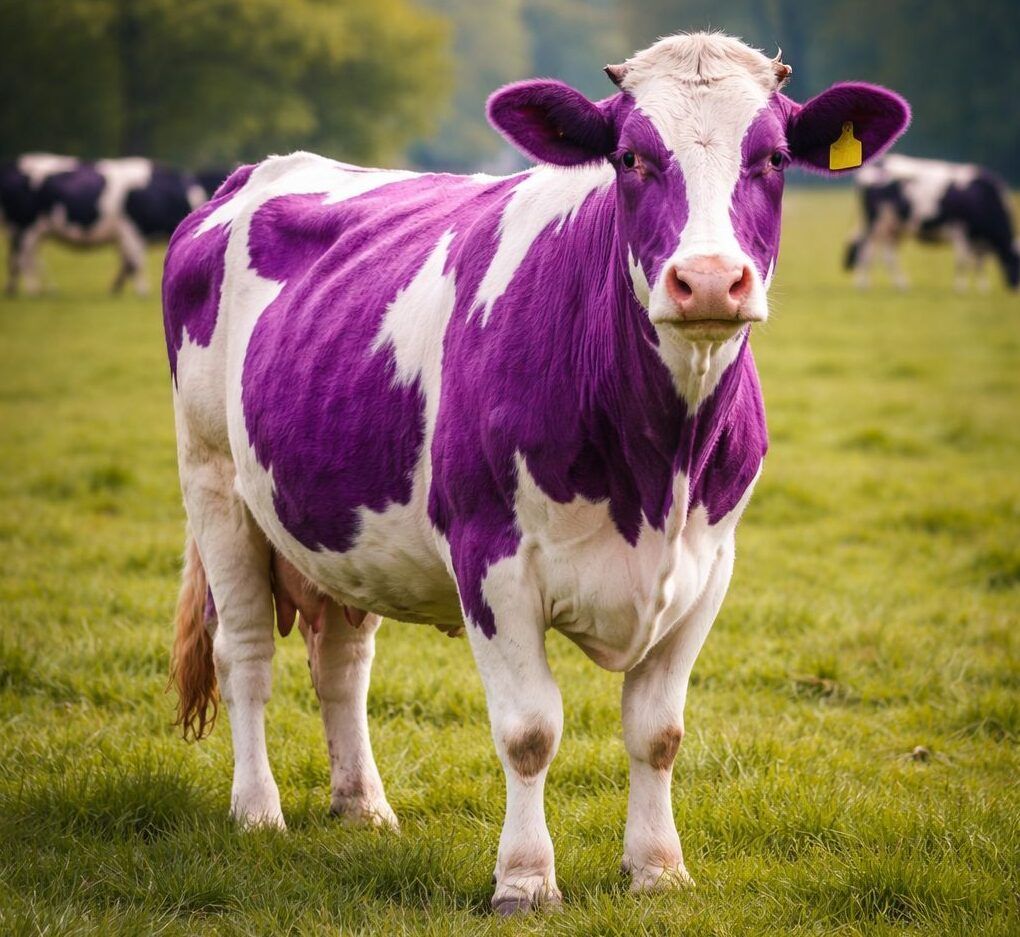
“Purple Cow” is Seth Godin’s metaphor for standing out. In a market where much is the same, it is the remarkable that gets noticed.Source: Seth Godin, Purple Cow (2003).
What will set brands apart going forward is therefore not how much they publish, but how clear they are. Identity, perspective, and direction carry more weight than the pace of production.
At the same time, this does not apply to all markets to the same extent. In markets where products are well-known and decisions are made quickly, standardized and efficient communication may be sufficient. But in highly competitive and more complex markets, it is a distinct and recognizable identity that makes the difference.
Coca-Cola and AI in marketing: when technology takes up more space than the idea
The Christmas campaign that became a global talking point
When Coca-Cola’s new Christmas campaign aired on screens last holiday season, it quickly attracted international attention. The campaign sparked both enthusiasm and clear criticism.

When technology takes too much focus
What was interesting was not the technology itself, but how it was perceived. For some, the emotions came from Coca-Cola’s established Christmas narrative and not from AI. For others, the technology became too prominent, and the campaign was discussed more as a technology project than a brand idea.
“AI is an effective tool, but it has no inherent understanding of relationships or emotions. When something feels genuine and emotional, it’s because people have set the direction and evaluated the quality,” says Kamilla Krane, Commercial Director at Solid Media.
When technology becomes the main story, the concept risks fading into the background. And when the emotional foundation is weakened, the brand’s ability to create connection is weakened as well.
Established brands can withstand more than less established ones
Established brands like Coca-Cola have invested in brand building over a long period of time, which gives them greater room to maneuver. They can afford to experiment and withstand criticism.
Smaller brands don’t have the same safety net. For them, incorrect use of AI can more quickly undermine credibility, relationships, and trust.
What does AI mean for brand building going forward?
AI represents both a levelling force and an opportunity.
– For smaller players, AI can lower barriers and make it easier to compete for visibility. For example, a small player can to a greater extent compete for the same apples as larger competitors, Krane points out.
At the same time, established brands have other advantages: history, trust, distribution power, and existing preference, as in the Coca-Cola example.
This means the starting point is different, but the need is the same. Regardless of size, a clear identity and strategic direction become critical. When production is no longer the main constraint, the pressure shifts to what actually creates differentiation.
– Going forward, companies must be conscious of what they stand for, who they are here for, and what value they create. Because when everyone has access to the same tools, it is the direction that determines the impact, Krane continues.
AI amplifies what already exists, both in terms of strengths and weaknesses.
The human factor becomes the competitive advantage in AI marketing
AI will shape marketing and branding over the next five years. The pace is accelerating, production is becoming easier, and the barriers to creating and distributing content are getting lower.
But when the technology becomes standard, the competitive advantage shifts elsewhere. AI is a powerful tool for efficiency and production, but it still lacks human judgment, context, and emotional understanding. That’s why ideation, strategy, and quality control must still be led by people.
Build a brand that can withstand the AI future
We help businesses build brands that are ready for change: from strategy and positioning to identity, content, and channel selection. We make sure people set the direction, and that technology is used to amplify what makes you unique.
Do you want to stand stronger in an AI-driven market? We help you set the direction. Take the first step and get in touch with us for a friendly conversation about how we can support you.