

Our experience with ChatGPT
ChatGPT and other AI tools have undoubtedly become valuable in SEO work, and this has significantly impacted digital marketing over the past year or so. In both of our disciplines (SEO and paid advertising), we have integrated the chatbot as a helpful assistant in a busy workday. In the SEO department, we mainly use it today for inspiration and to streamline some time-consuming tasks. Read more about how AI is impacting our marketing here.
It is important to emphasize that AI technology is still at an early stage, and for that reason we do not use AI for production – but as a support tool and sparring partner, says Kristoffer Moen, Head of the SEO department at Solid Media.
In addition, Google has increasingly emphasized the importance of content quality on websites, which means that generic content produced by ChatGPT will not be valued.Read more about how you can combine AI with Google’s guidelines for high-quality content here
ChatGPT briefly explained
ChatGPT is an AI chatbot developed by OpenAI, based on a large language model called GPT (Generative Pre-trained Transformer). By leveraging machine learning, natural language understanding, and a dataset of text from the internet, it can generate human-like, text-based responses to a wide range of questions and topics.
What is the difference between the free and paid versions of ChatGPT?
ChatGPT is available in two versions, where ChatGPT 3.5 is free and the newer ChatGPT 4 is paid. The difference between them is that ChatGPT 4 can handle more complex tasks and delivers more nuanced responses, compared to ChatGPT 3.5 which is more limited. We have tested the prompts in this guide using the paid version, ChatGPT 4.
Limitations of ChatGPT
You can use ChatGPT for a lot, but it’s important to remember that ChatGPT retrieves information from a specific point in the past, and that it cannot fetch or analyze real-time data. To get detailed and up-to-date analysis, you need to perform thekeyword analysis yourself and combine ChatGPT with other SEO tools, such as Google Analytics, Google Search Console, Ahrefs, Sistrix, and Keyword Tools.oi. In addition, you should fact-check the content against reliable sources.
ChatGPT works well for answering questions and solving tasks with specific instructions. What it is less capable of is conveying in-depth, experience-based content with reflection and perspective. That still requires human expertise, says SEO specialist Bjørn Marius Narjord from IntentSEO.
How can you get the most out of ChatGPT?
To get the most out of ChatGPT, you need to ask good questions/prompts. This requires an understanding of how the model interprets and responds to input. Here are some general tips for crafting effective prompts:
- Be specificInclude all relevant details that can help the AI understand the context and purpose of the question or task.
- Clearly define what you wantSpecify exactly what kind of information or outcome you expect. If you want a creative draft, an explanation, a summary, or technical guidance, state it explicitly in your prompt.
- Use clear and simple languageEven though ChatGPT has an extensive understanding of language, it is best to avoid unnecessarily complex wording, slang, or highly specialized technical terms without explanation.
- Structure your promptIf you have multiple questions or need answers on different aspects of a topic, it can be useful to break the prompt into smaller, manageable parts. This makes it easier for it to provide precise answers to each element.
- Include examplesIf you’re asking about complex concepts, it can sometimes help to include an example to clarify what you’re looking for.
- Adjust along the wayDon’t be afraid to experiment with different phrasings of your prompt. If the first response doesn’t fully meet your expectations, try refining the prompt based on the response to get a more satisfactory answer.
- Set boundaries and constraints If you need an answer within a specific boundary or constraint (e.g., a word limit, a specific format, or within a particular context), include this in your prompt.
- Be open to learningAs with any technology, there is a learning curve to writing effective prompts. By observing how different prompts influence the responses, you can fine-tune your approach over time.
It can be useful to include this sentence at the end of your prompts “before you do anything else, did you understand the task?” so that you can see how ChatGPT interprets the request. This gives you the opportunity to see what information and details are missing and, before it starts on the task, says Kristoffer Moen.
How can you use ChatGPT in your SEO work?
1. Get inspiration for keywords
Keyword research takes a lot of time. That’s why it can be useful to ask ChatGPT to suggest popular keywords within a given topic. Even though ChatGPT cannot directly perform searches with real-time data, it can suggest potential keywords and topics based on prior knowledge or the text you provide.
Here is an example of such a prompt:
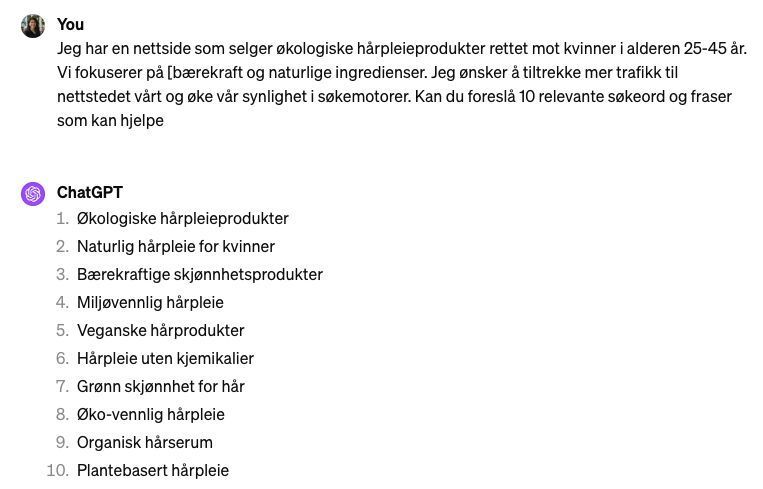
Copy the prompt to get inspiration for keywords:
I have a website that sells [organic hair care products targeted at women aged 25–45]. We focus on [sustainability and natural ingredients]. I want to attract more traffic to our website and increase our visibility in search engines. Can you suggest [10] relevant keywords and phrases that can help me achieve this goal? Before you proceed, do you understand the task?
2. Group keywords and build topic clusters
Once you have created a list of relevant keywords, the next step is to group them. To sort, group, or categorize these, ChatGPT is a valuable partner. We can use ChatGPT to sort keywords by different themes that belong together in a topic cluster, or to categorize keywords based on location names, or whether they are keywords that start with “what is”.
Here is an example of such a prompt:
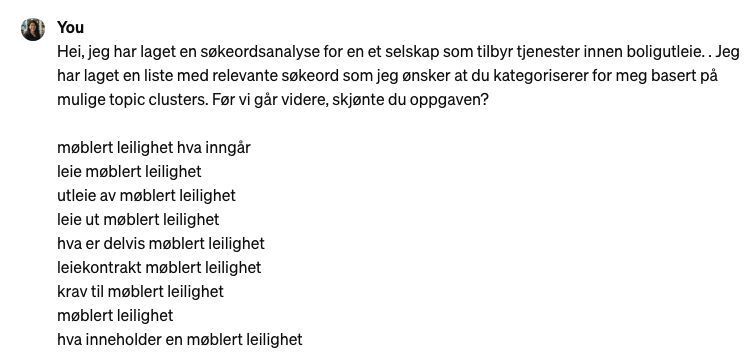
Copy the prompt to group keywords and build topic clusters:
Hi, I’ve created a keyword analysis for a company that offers services [within residential rental]. I’ve compiled a list of relevant keywords that I would like you to categorize for me based on potential topic clusters. Before we proceed, did you understand the task?
3. Create engaging metadata
ChatGPT can help create short, engaging, and SEO-optimized meta titles and descriptions for websites, which are important for click-through rate (CTR) from search results.
Here is an example of such a prompt:
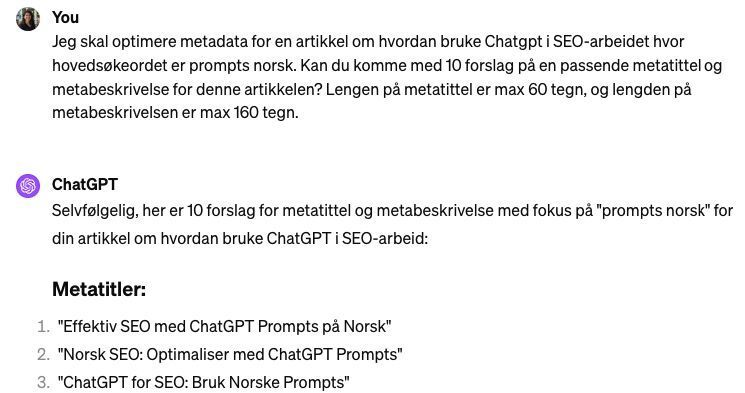
Copy the prompt to generate suggested metadata:
I want to optimize the metadata for an article about [hvordan bruke Chatgpt i SEO-arbeidet] where the main keyword is [prompts norsk]. Can you provide 10 suggestions for a suitable meta title and meta description for this article? The meta title can be a maximum of 60 characters, and the meta description a maximum of 160 characters.
4. Using ChatGPT for content support
Writing strong SEO content can be challenging for many. You need knowledge of different topics or solid research skills, strong writing abilities, the capacity to weave keywords naturally into the text, while also staying up to date in the field. This is where ChatGPT can be useful, by suggesting content ideas, generating outlines, correcting spelling mistakes, structure, and improvements. It can inspire you, reduce the time you spend, and provide you with a first draft.
Here is an example of such a prompt:
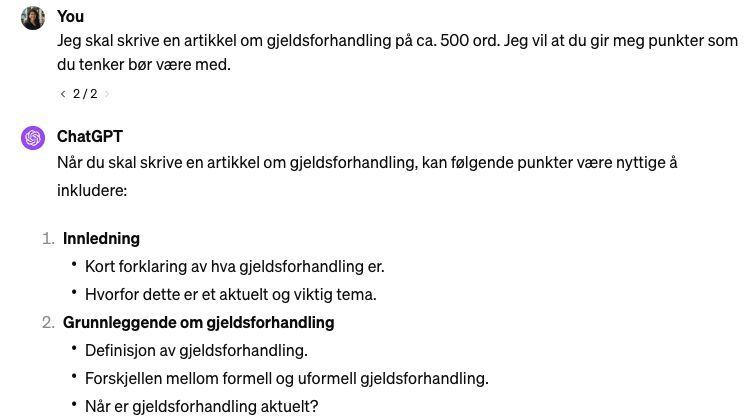
Copy the prompt to generate an outline for articles:
I am going to write an article about [gjeldsforhandling] of approximately 500 words. I want you to give me the key points you think should be included.
Some follow-up prompts:
- Get more information about the target audience:What do you think the target audience needs answers to related to [the topic]?
- Table of contents Give me suggestions for a table of contents for a guide about [topic].
- Writing tips Give me suggestions for a catchy headline that grabs the attention of the target audience for this text [tekst].
- Definitions Give me a short definition that clearly explains what [søkeord] is. Max 100 words.
- Summary of a given topic:Write a 100-word summary that captures the key points of [the article/topic].
5. SEO optimization
When you need to optimize an SEO text, it can be difficult to know where to start. By asking ChatGPT, you can reduce the time you spend and get suggestions for improvements it recommends.
Here is an example of such a prompt:
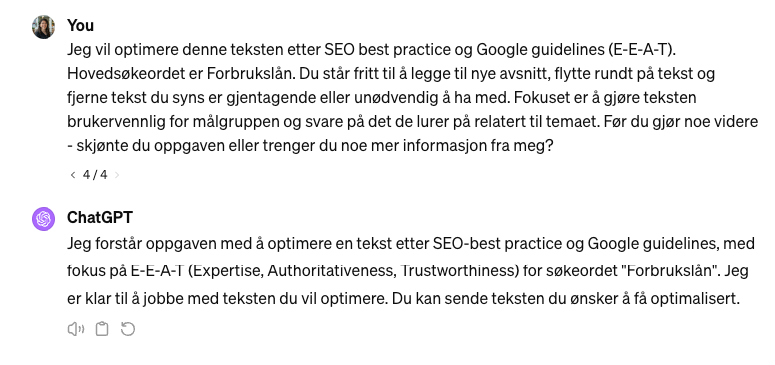
Copy the prompt to improve your text based on best practice and EEAT:
I want to optimize this text according to SEO best practice and Google guidelines (E-E-A-T). The main keyword is [Forbrukslån]. You are free to add new paragraphs, rearrange the text, and remove any content you find repetitive or unnecessary. The focus is to make the text user-friendly for the target audience and answer what they want to know related to the topic. Before you proceed – did you understand the task, or do you need any additional information from me?
Improve the text by adding an FAQ:
- Read the blog post [paste the text] and suggest 3 questions a reader might have that are not answered in the article.
- Next: Now answer the questions. Avoid bullet lists.
- Take the 3 questions and answers and add them as FAQs at the bottom of the blog post.
Conclusion
Even though you should be critical of the answers ChatGPT provides, it will still be useful for research, structuring, copy support, and SEO optimization. For now, the ideal approach is a sensible use of these AI services as support tools and helpful assistants. Strong content will be rewarded by Google when it delivers value through experience-based insight (E-E-A-T).
How to succeed with SEO? Read our SEO guide, which explains how you can work with SEO in practice here.
Frequently Asked Questions
Can you use ChatGPT in Norwegian?
Yes, ChatGPT can be used in Norwegian and many other languages. It understands and generates responses based on the language of the request.
Where does ChatGPT get its information?
ChatGPT draws information from a large dataset that includes books, websites, and other texts up to its most recent training, which was in April 2023. It generates responses based on patterns and knowledge derived from this data.