
What is a keyword analysis?
A keyword analysis is an analysis of which keywords you should choose for your website. A keyword can also be referred to as a nøkkelord or a keyword. The keyword analysis is about identifying and evaluating the most relevant keywords people use when they search for information, products, or services online.
The goal of the keyword analysis is to identify the most relevant keywords, based on search volume (demand) and search intent (the searcher’s purpose). By understanding user intent and optimizing your website with relevant keywords, you will attract the right target audience to the right pages.

Why is it important to conduct keyword analyses?
As an SEO agency, we far too often see that the customers we work with do not have a sufficiently robust keyword analysis in place. This means they miss out on many relevant visitors through søkemotorer. A thorough keyword analysis will give you the answer to which keywords you should optimize your website for to increase visibility and attract traffic that can be converted into valuable customers.
Keyword analysis helps you identify keywords that are relevant to your target audience. This enables you to create content you know your audience is searching for. The analysis also gives you the opportunity to analyze competitors and see which keywords they are targeting. This can help you refine your own strategy.
Focusing on the most relevant keywords delivers better results for both paid advertising and organic search engine optimization. You align what you sell with what your target audience is searching for. With a keyword analysis, you can map which keywords your potential customers use. You can then optimize the content on your website to meet their needs.
Or you can get help from us – read more about how we can support you with a keyword analysis here.
Step 1: Define objectives and target audience
Before you start your keyword analysis, you need to clearly define what you want to achieve. Identify the objectives for your website and understand who your target audience is. Here are some questions you can ask yourself:
- Which services or products do you want to focus on?
- Which services or products generate the most revenue for you, or which products/services are not selling so well today?
- Is the goal to increase the overall traffic to the site, or to a specific service or product?
- Who do you want to reach? Who are the typical customers for what you sell?
Which search phrases do your customers use?
Based on which pages on your website you want to drive more traffic to, which search phrases do people use when they look for what you sell?
Let’s look at an example:You run an online store and sell different types of tents. On your website, the category is called “tents” and it shows the full selection of all the tents you sell. The keyword “tents” has 110,000 searches per month; this is a keyword with high search volume and strong competition. It will therefore be difficult to achieve a top ranking for the keyword “tents” in Google.By conducting a keyword analysis, you discover that there is a high search volume for different types of tents. Here is a list of related searches with monthly search volume:Party tent – 40,500 searches/month
Pop up tent – 12,100 searches/month
Play tent – 5400 searches/month
Camping tent – 2900 searches/month
Large tent – 1600 searches/month
Winter tent – 1300 searches/month
Bergans tents – 1000 searches/month
Family tent – 720 searches/month
Tent 6 people – 720 searches/month
4 person tent – 880 searches/month
By creating new pages or optimizing existing pages for these keywords, you will target more precisely what your audience is looking for. The more content you publish about different tents, the more Google will understand that you have expertise in tents. This will influence the relevance of your website, which will have a positive impact when Google decides what to display at the top of the results.
What content do you already have on your website?
- Start by reviewing the current state of your website. Map out what content you have today.
- Check whether any of the existing articles currently perform well for the target keywords. If they do, you can further develop them. If not, you need to create them!
- Deindex pages that compete internally. These are detrimental to your overall visibility.

Step 2: Create a list of relevant topics and themes
Identify the main topics and themes that are relevant to your business. This will form the foundation of your keyword analysis. Do this by creating an Excel sheet/Google Sheet.
- Start broad at a high level with keywords related to the type of business you run. For example, “digitalbyrå”, “digital markedsføringsbyrå” and “markedsføringsfirma”. Add all variations of terms for your business type in the sheet.
- Map out the keywords for your services or product categories so you get a complete overview of what the website offers. Give the most important services and products the most attention. For example, “søkemotoroptimalisering” and “annonsering”. Enter these categories into the sheet.
Which keywords are competitors using that make them rank high in Google? This will give you a solid understanding of the competitive landscape. We recommend that you go into incognito mode, search, and assess the competitors that appear in the top 5. You can use these insights as inspiration!
Step 3: Which keyword analysis tools should you use?
Use keyword analysis tools to identify which keywords and phrases are used in relation to different terms. With keyword tools, you can see how many people search for each term on average per month, and analyze trends to understand when during the year search interest is highest. You can also gain insights into the questions people ask related to the term.
Which keyword tool should you use?
To begin with, we recommend using free versions or trial periods of different tools. This will help you identify which one you feel works best. We use a combination of KeywordTool.io, Ahrefs, Google Search Console and Google Analytics. In our experience, these tools together provide a clear picture of what your potential customers are actually searching for.
Free keyword tools
This is our primary tool for keyword research. KeywordTool.io gives you insights into related keywords and phrases by pulling data from Google Autocomplete. You can identify popular search terms and understand which words people use when they search for specific topics. This provides you with valuable information to expand your keyword list. Here you gain insight into the average monthly search volume for each term and can see how it trends throughout the year. (You can use the free version, but you will get much more value from the paid version).
Google Search Console provides insights into how Google views your website. You can track search traffic, monitor website performance, and identify the keywords that drive visitors to your site. With Google Search Console, you can see which keywords and which pages on your website already have strong rankings and traffic, and which are not performing as well. If you haven’t set up a Google Search Console account for your website yet, you should do so now.
Google Keyword Planner gives you information about the search volume for specific keywords and helps you discover new keywords related to your business. This tool is particularly useful for planning and optimizing Google Ads campaigns.
Google Analytics gives you detailed insights into your website’s performance, including traffic, demographics, and visitor behavior patterns. It helps you evaluate the effectiveness of the keywords you use and adjust your strategy in line with user behavior.
Google Trends lets you identify trends in keyword usage over time. This is useful for adapting your content to seasonal variations and shifts in audience interest.
Ahrefs offers limited free functionality, including a Keyword Generator that provides suggestions based on single words or phrases. This tool also provides information on search volume and the level of competition for the keywords.
Answer the Public helps you identify questions and popular phrases that people search for around a specific topic. This tool is useful for creating content that directly answers users’ questions.
Keyword Surfer is a Chrome extension that provides data on search volume, cost per click, and other relevant SEO metrics directly in the search results. This is useful for quick keyword analysis while you are searching on Google.
Paid keyword tools
This is our primary tool for keyword mapping. With the paid version of KeywordTool.io, you gain insights into all related keywords, phrases, and questions by pulling data from Google Autocomplete. You can identify popular search terms and understand which words people use when searching for specific topics. This provides you with valuable information to expand your keyword list. Here, you also get insights into the average monthly search volume for each term and can see how it trends throughout the year.
Ahrefs is a comprehensive tool that provides detailed insights into keyword competition, backlinks, and the overall health of your website. It also offers functionality to analyze your competitors and optimize your content.
Moz offers features that help you with keyword analysis, site monitoring, and identifying SEO opportunities. The tool also provides rank tracking and insights into your website’s health.
SEMRush provides in-depth insights into organic and paid search traffic, competitive analysis, and rankings. It is a versatile tool that covers many aspects of SEO and digital marketing.
TinyRanker focuses specifically on rank tracking and gives you an overview of how your selected keywords perform in the search engine results. It is a simple yet powerful tool for keeping an eye on your positions.
KWFinder provides information on search volume, difficulty, and cost per click for specific keywords. It is particularly useful for finding low-competition keywords with solid demand.
Step 4: Select keywords and organize them
Write down all the keywords you find, group them by type and search volume, and make sure you’ve captured all possible combinations. You can also easily find synonyms for the keyword by using synonymordboka.
Review the results from the keyword tool and select keywords that are relevant, have search volume, and align with your objectives. We recommend categorizing these in an Excel sheet/Google Sheet.
How to choose keywords?
- Evaluate search volumeSearch volume indicates the number of monthly searches a keyword has. When keywords have high volume, it signals strong demand related to that term. It is common to choose keywords with high volume. However, it can be more effective to select keywords with lower volume if they lead to high-value sales.We distinguish between short tail keywords and long tail keywords. A short tail keyword consists of one or two individual words, such as “running shoes”. This type of query typically has a high search volume and returns a broad range of results.There is often lower search volume for long tail keywords (longer search phrases). The advantage of long tail keywords, however, is that the search is more specific, and the user is often further along in the customer journey. An example of this is “white running shoes women flat feet”.
- Assess the competitionAssess the competition and make sure to include both short and long keywords. You can easily do this by googling the keyword and reviewing what the competitors at the top of the search results are writing about.
Conduct an intent analysis to check search intent Search intent plays a major role in matching keywords with your target audience. By doing a Google search for the keyword, you can see what comes up. This allows you to verify whether the intent you had in mind for the keyword is correct. Look at what appears in the top 5 results – and aim to answer the search even better. If the search intent is not met, Google will not highlight your content.
The intent behind different searches will vary. Some searches are clearly purchase-related. For example: “Trekke visdomstann Oslo” or “Hotell i København”. These search phrases indicate that the searcher is ready to make a decision about a specific service. Other searches are more information-seeking. For example: “Hvor lenge skal et egg koke?” or “Hvordan farger jeg håret selv hjemme?”.
You can categorize the search intent based on where they are in the purchase funnel:
- Awareness – the searcher is looking for information about the topic
- Consideration – the searcher is evaluating different options
- Ready to buy – the searcher knows what they want and is ready to purchase
It’s important to focus on the keywords that support your goal. If your goal is to drive as much traffic as possible to your site, you can create articles that answer questions related to what you sell. As in the tent example, you can write articles like “How to set up a tent?” and “What do you need to bring on a camping trip?”.But if you already have a lot of traffic to your site and want to increase sales, it becomes more important to optimize for purchase-related searches.
Step 5: Implement the keywords on your website
Integrate the selected keywords naturally into the website content, meta titles and descriptions, title tags (h1, h2, h3), and other relevant areas. This helps improve the website’s visibility in the search results (SERP).
Create a publishing plan
To do this in a structured way, you can create a publishing plan to keep track of what needs to be done. Create content that highlights different angles of important keywords/phrases/topics. You do this by assigning the keywords you have identified to their relevant topic. Next, you decide which keywords should be allocated to service pages, articles, guides, category texts, etc. A publiseringsplan will make it easier to keep track of which new pages need to be created and which pages you should optimize based on the selected keywords.
Categorize the keywords with topic clusters
A topic cluster is a way to group the pages that exist on a website. In the publishing plan, this is a strategic way to map your content across different themes. By using this actively in content production, you ensure a solid structure on the website. You create a topic cluster for each theme, consisting of a main page (pillar page) that links out to subpages (cluster pages). The subpages should also link back to the main page. This helps Google understand which pages are related, and how broad your expertise is on the topic.Read more about topic clusters here.
Step 6: Evaluate and update regularly
Search engine algorithms change, and user behavior evolves over time. That’s why it’s important to review your keyword analysis regularly and update your strategy based on new trends and developments in the industry. Conducting a thorough keyword analysis is an ongoing process that enables you to adapt to changes in the market and the needs of your target audience.

Example of a keyword analysis
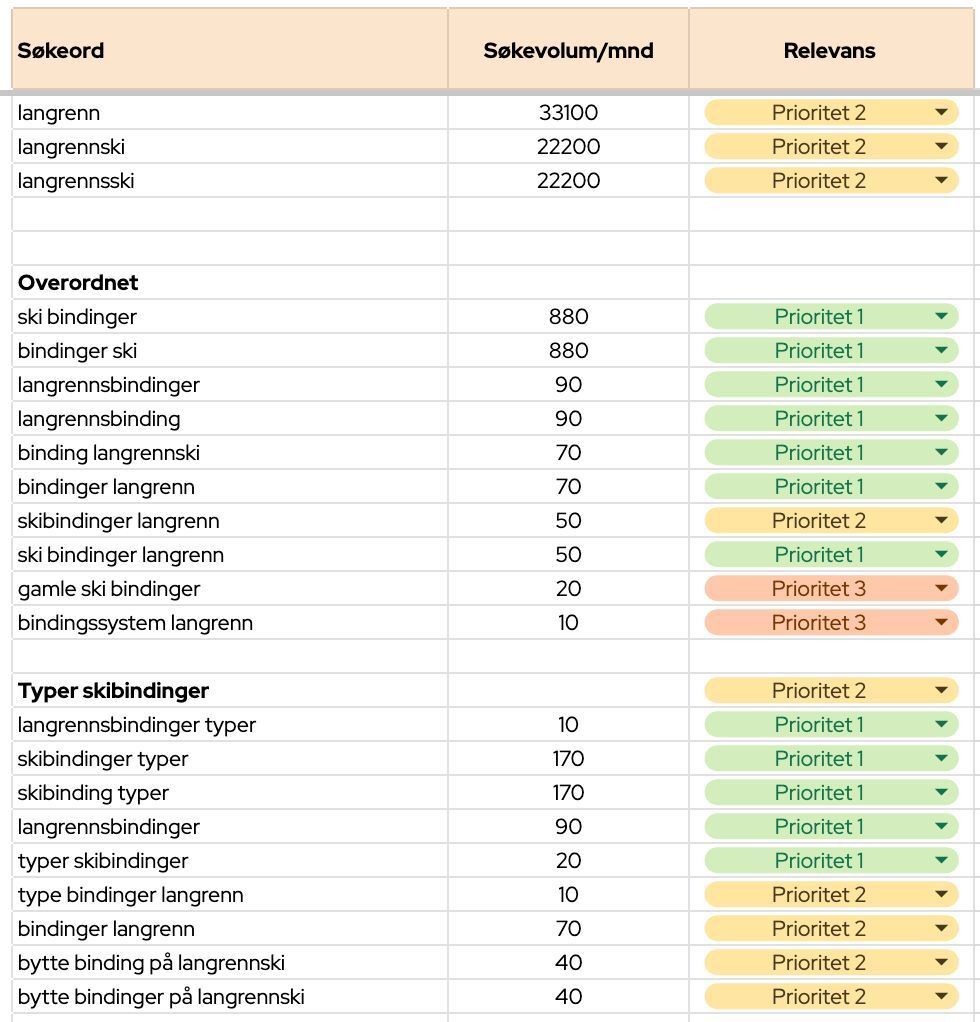
This is an example of a keyword analysis for a website that produces cross-country and mountain ski bindings. It is important for us to initially narrow down our analyses to one topic that we will focus on and learn more about.
We chose cross-country skiing as the topic and entered the related search phrases into an Excel spreadsheet. The most important thing for us, after following the steps in the keyword analysis, is what we do with the analysis and how we use it going forward.
In this example, you can see in the image below how we grouped the keywords, included monthly search volume, and added a column for relevance. Here, you need to make your own assessment of which findings you consider most relevant.
There is a lot more information you can include in the analysis, such as keyword ranking difficulty and CPC, so you can assess the demand. But we prefer to work step by step – and it’s important to keep it simple!